
Mindfulness has become so popular that it’s used as a tool for stress relief right across our society, even in schools. The modern practice of mindfulness is a westernised version of a Buddhist meditation, which teaches that thoughts don’t need to be controlled. It upends the notion that we need to control our thoughts and encourages us to become the observer rather than the thinker.
Essentially mindfulness draws on awareness to help us be present in every moment. Supported by extensive studies, it is a potent tool to combat the high stress levels we all experience every day. Like other forms of meditation, it improves our mental health while increasing our brain processing power. Mindfulness is a very simple technique that can be used every day to find inner calm.
Mindfulness practices are often taught secularly, but their roots reach back to ancient teachings and traditions.
Mindfulness is also known by terms such as mindful awareness or enlightenment. It has a rich history, and its roots are steeped in many ancient religious and more recently, secular traditions, in particular Buddhism and Hinduism.
The Beauty Of Mindfulness
Part of the beauty of adopting a mindfulness practice is that the many health benefits can be gained anywhere, anytime and either in a group or alone. Even just two or three minutes a day can trigger the benefits.
While breath is an important aspect of mindfulness, it takes many forms and can be adapted to suit every individual. These forms include awareness, meditation, yoga, walking meditation or becoming mindful during everyday activities such as washing the dishes, showering, eating or drinking tea.
In simple language mindfulness is non-judgemental awareness
Most of us rush through our day, our week, our lives, without noticing our surroundings and remaining unaware of deeper currents. This leaves us operating on autopilot. In this state we become vulnerable to life upsets and stress. We are left to fall back on the old stories that underpin our subconscious beliefs, which drives us to repeat long-held practices that do not support our growth.

Develop Conscious and Intentional Awareness
In the midst of navigating this busy-ness, what’s far more crucial to our wellbeing is what’s really going on behind the events in our lives. When we are always rushed and overwhelmed we generally fail to notice the real story behind what’s happening. If we do happen to get a small glimpse of that story, we quickly respond with an opinion about it rather than gaining real clarity by stepping back and just observing.
Mindfulness, a conscious and intentional awareness, gives us the means to avoid living on autopilot. By developing our ability to observe and really notice things happening around us and to us, we become tuned into how we habitually react and respond to them, without attaching any personal judgement.
We are able to notice what’s going on without becoming drawn into the drama.
We develop an ability to observe with greater awareness which helps us make wiser decisions for ourselves and our life, to carry us forward in greater clarity without anxiety and overwhelm.
However, being able to draw on heightened awareness coupled with greater calm and acceptance doesn’t just happen automatically. We need to develop this ability within ourselves, and like any new mind skill, it takes practice and time.
Initially we may only be able to sustain a mindful state momentarily. But if we are committed to changing so we can shift from a state of constant overwhelm and drama into one of open, stable, grounded calmness. We can begin to expand our mindfulness and start noticing change quite quickly.

7 Mindfulness Exercises To Reduce Overwhelm
To change how you respond to drama and stress you have to break old habits while also developing new ones. This means you no longer automatically react to triggers and instead, are able to step back, observe with awareness, and identify both the trigger itself and the way you normally respond. Once you become aware of this habit within yourself it becomes easier to break it apart.
These simple mindfulness exercises will help you develop conscious awareness to reclaim a calmer, more coherent presence when faced with life’s challenges. Practice them over and over until you start to notice yourself staying calm without reacting.
1. Awareness Exercise
This exercise helps develop your ability to observe with clarity by uncovering where you place your attention through the day. It also highlights what distracts you from staying calmly in the present moment.
Take a few minutes to walk around the place you are right now, a room at home, work or even outdoors. It doesn’t matter where it is, just go with the place you are in.
Do this without holding any intention or expectation about what will happen or what you hope to achieve in the practice. Just move to whatever draws your attention.
Do this for about three minutes. Then write down on paper preferably, or in your phone, whatever you noticed, what drew your attention or where your thoughts shifted during that time. It’s important to actually record these.
You may:
- Have past thoughts rise up
- Wonder about future job opportunities
- Create vague plans for a family holiday
- Try to find a solution to a problem
- Criticise yourself
- Remember something you’ve forgotten to do
- Think about how tired or hungry you are
- Became sad, lonely, frustrated, angry, guilty or any other emotion about something or someone

2. Breath Of Life Exercise
A minute or two of deep breathing from your abdomen helps to bring you the calming benefits of mindfulness. This is partly because when you’re completely focused on the movement of your breath you can’t think of other things, you’re living in the moment.
The emotional response to a challenge and the subsequent chaos of your thoughts throws you into a downward spiral of anxiety and overwhelm. Focused breathing takes you out of your thoughts and into your body so you can’t continue to be caught up in the drama.
Breathing from your belly is something you need to cultivate as your automatic way of breathing, all the time. Most people only use the top of their lungs to breathe which is inefficient. Once you set the intent to make abdominal breathing your natural breath it is easy to simply switch your attention to your breath whenever you need to quickly ground yourself to deal with stress.
I describe this process in detail in this blog post about using deep breathing to reduce stress.
Basically, sit up straight in a chair with your feet on the floor or stand. Close your eyes. Focus on your breathing, drawing the breath down deep into your abdomen.
Follow each breath in and out. It can help to place your hands on your belly and feel it rise or expand with the in breath and fall or contract with the exhale. After one minute open your eyes and go about your day.
Your diaphragm, belly and chest should expand as you breathe in and soften as you breathe out. Your shoulders should not move up and down when you do this breathing correctly.
Practice whenever you can so you can immediately and automatically turn your attention to a minute or two of deep breathing whenever you need it. You’ll discover it immediately calms you and reduces any strong emotional feelings or anxiety you might experience.

3. 4-4-4 Exercise
This is another simple breathing exercise to focus your awareness and strengthen your mindfulness practice.
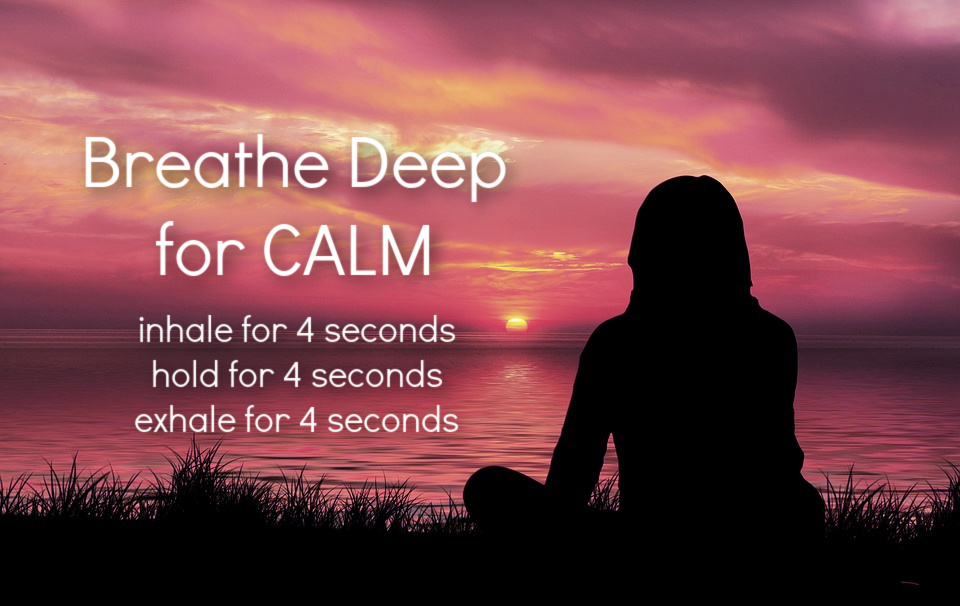
1. Turn your attention to your breath.
2. Inhale steadily to the count of four.
3. Hold your breath for the count of four.
4. Exhale for a count of four.
5. Hold for another count of four.
Repeat this for a minute or two.
Do this exercise in conjunction with abdominal breathing.
4. Water Immersion Exercise
Water is linked with our emotions so this next exercise is useful because our emotions are triggered by stress and are released through this mindful practice. This exercise focuses your attention on the input you receive through your senses.
The shower is a great place to pay attention!
Whenever you take a shower develop mindfulness by becoming aware of your five senses.
Notice the action of turning on the taps. Notice the feel of the water as you step under, the feeling of it on your skin as it flows down your body.
Smell the aroma of the soap and notice the sensation on your skin as you lather. Observe how your skin feels after the soap is washed away. Feel the steam around your face and watch it as it drifts upward.
Now turn down the hot water for a few seconds and then turn it back up, noticing the change in temperature.
Throughout keep your attention focused on what you sense – what you feel, smell, taste, see and hear.

5. Pause For An Entrance Exercise
For mindfulness to become a positive part of our life it needs to become second nature to us. This exercise helps us start acting mindfully in even the smallest activities of our lives so we start to engage mindfully all the time, without having to think about it.
Generally we rush through doors moving from one space to another without consciously making the shift from the first space to the next.
As you approach a door, pause, before reaching for the handle. Take a couple of mindful breaths. Then go ahead and open the door. As you pass through the door pay attention to closing the door behind you before turning to the new space.
Take a moment to mindfully move your attention to the new space before moving into it.
Do this process and take a moment to pause, whenever you move from one space to a new one, even if a door is not involved.

6. Mindful Eating Exercise
This exercise is similar to the shower exercise and aims to focus your awareness on your senses.
Often we rush through our meal, eat on the run, or engage in other activities while we eat. Mindful eating has two basic principles – slowing down and engaging fully with all our senses.
Whether you are eating a full meal or a simple snack bringing mindful awareness into the process gives all the normal health benefits of mindfulness as well as improving our digestion.
First, don’t eat on the move, sit down or at least stop.
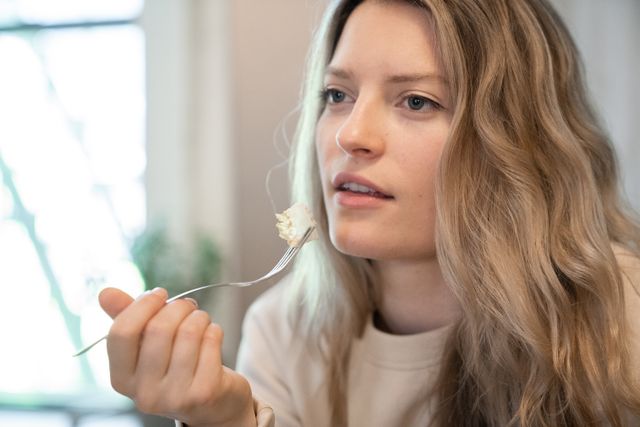
Before you begin to eat look at the food, notice the colour, shape or anything unusual about it. Bend close and breathe in the aroma, noticing what you identify; close your eyes if it helps.
Pick up your food or touch it and notice what it feels like. Is it heavy or light; warm or cold; soft or hard, slippery, fluffy, squelchy? Notice any utensils you’re using, the weight, surface, shape, the detail.
Now take a small bite. Let the food sit in your mouth before you chew it and notice it on your tongue. Notice the texture. Savour the taste. Notice how it feels as you swallow it.
Listen for sounds throughout the process, the crinkle of paper as you unwrap it, the clink of the cutlery, the scrape on the plate and the sound as you chew.
Take time to become deeply aware of the process and the sensations you experience at all stages.
7. Time Out Exercise
To remind you to continue to develop your mindfulness practice keep a timer near you, on your desk, beside your bed or wherever you spend your time.
Whenever you notice anything holding your attention or curiosity, such as an interesting sound, a bird outside the window or the play of light on the wall, start the timer for one minute. As you continue to notice, slow your breath continuing to focus on whatever caught your eye.
When the timer beeps check in with yourself. How do you feel? Do you feel calmer, peaceful, more relaxed?
The Core Message
Mindfulness is both a noticing, or awareness, of all that surrounds you in the external world, and an acceptance of whatever you notice both within and outside yourself, without judgement. That part is important!
The goal when developing a mindfulness practice, is to have it become an automatic way to move through your day, not something you need to focus on. So, the more you do it the less you’ll have to remember it.
In order to make mindfulness a regular and automatic part of your life it helps to involve daily activities in your developing practice. For example, set the intent to deep breathe for 30 seconds every time you pick up your keys, or climb the stairs, turn on the tap or any other action you regularly take. You can use any routine activity to helps you strengthen mindfulness.
Begin to incorporate these exercises into your daily routine whenever you remember and use them to help you move out of feelings of stress, overwhelm, anxiety, or confusion.
Disclaimer
All information and opinions presented here are for general health information only and are not intended as a substitute for professional advice offered during a consultation. Please consult with your health care provider for medical conditions before trying treatment suggested on this site.
© Catherine Bullard and Happy Holistic Health, 2026. Unauthorised use and/or duplication of this material without express and written permission from this blog’s author and/or owner is strictly prohibited. Excerpts and links may be used, provided that full and clear credit is given to Catherine Bullard and Happy Holistic Health with appropriate and specific direction to the original content.

