

Is the air in your home polluted?
When we make changes that improve our wellness, one place we often forget is in our home. We concentrate on exercise, improving out diet, balancing supplements, adopting practices like yoga or mindfulness. But often we don’t even consider that the air inside our home may be highly polluted. We may not even realise that our home may contain toxic air.
One simple and straightforward way we can improve this is to grow indoor house plants for a healthy home. But often the underlying problem needs to also be identified and fixed if we are to gain the full benefits.
Causes Of Toxic Air
Identifying the quality of the air inside our homes, schools and workplaces now falls to Building Biologists.
Building Biology is a relatively new holistic discipline which examines and identifies irritants and hazards in residential and public structures. These include building materials, the products we use, air quality, water, biological contaminants (mould) and pest control, as well as electromagnetic fields (EMF’s) radiation (EMR) and geopathic stress.
It developed in response to a growing awareness of the impact toxic components in our immediate environment are having on our health. According to Building Biologist Nicole Biljsma it “provides a holistic examination of the built environment and provides realistic solutions to create buildings that support mind, body and soul.”
When problems with the air quality within buildings are found the first line of attack is to eliminate the source of pollution. Pollution may be caused by building materials, furnishings, products used within the space, pest control, or cleaning methods.
Once the source of the pollution has been addressed the next step to achieving clean air is to install air purifiers and filters. This is where plants come in.
Natural Remedies For Indoor Pollution
Before you buy an expensive electric air purifier for your home consider that bringing household plants is one very simple, but potent way to improve air quality in your home.
It’s said plants are the lungs and kidneys of the building. Research at NASA’s Space Center supports this and has shown that the presence of certain indoor plants actually improves indoor air quality.
The plants are able to grab and filter common pollutants found indoors and so purify the air.
NASA has made a list of the most beneficial plants in order of their effectiveness.
Why Our Homes Are Polluted
Many of the products we use to furnish our homes, schools and workplaces including carpet, fabric, wall coverings, furniture and paints contain highly toxic chemicals. These toxins are released into the air, creating indoor air pollution.
In 2009 the US Environmental Protection Agency stated that “The air within our homes can be seriously more polluted than the outdoor air in even the largest and most industrialized cities”.
Many newer homes are designed to intentionally ‘seal in’ the air. This is done to better regulate the internal environment and reduce the use of carbon fuels for heating and cooling.
Living in these sealed homes can result in a disorder known as Sick Building Syndrome.
Sick Building Syndrome
Sick Building Syndrome is a recognised disorder which results from the build-up of toxins in our environment. One of particular concern is formaldehyde.
Simply introducing plants into the environment can greatly reduce these problems.
This disorder is becoming more widespread with the increase of energy efficient buildings. These sealed buildings allow little exchange of fresh outdoor air for the stale, polluted indoor air. This leads to the indoor air becoming ten times more polluted than the air outside. In developed societies we spend up to 90% of our time indoors. Therefore, we are now spending most of our life in extremely toxic surroundings. Indoor air quality is quickly becoming a particularly concerning health problem.
Research from the Environmental Research Laboratory of John C. Stennis Space Center has shown that rooms filled with the right plants have 50-60% fewer airborne moulds and bacteria than those without plants.
We know that plants take in carbon dioxide and release oxygen. But it appears the plants can also suck toxic chemicals out of the air by absorbing the pollutants into their leaves. They then transport them to the roots where they are transformed into food for the plant.
NASA findings show that plants are able to remove up to 87% of air toxins over 24 hours.
Indoor plants can bring a host of physical and mental health benefits.
Amazing Benefits Of House Plants
Houseplants purify the air in a number of ways.
The air in environments with ducted heating dries out quickly, causing respiratory congestion and dry skin. Plants are ideal additions in these situations. They balance humidity levels by maintaining the moisture levels in the air at an optimum level. They maintain a level which is low enough to reduce illness and at the same time, high enough to prevent mould formation.
The Norwegian University of Agriculture found indoor plants fight certain illnesses. With indoor plants in the space the symptoms of these health problems reduced.
- Fatigue by 20%
- Headache by 45%
- Sore/dry throat by30%
- Coughs by 40%
- Dry facial skin by 25%
Other research has shown house plants have a psychological benefit. They increase self-esteem, improve mood, reduce stress, anxiety and depression and increase feelings of calm, relaxation and optimism.
With their ability to improve the effects of stress and reduce blood pressure levels, the important role of indoor plants in a society with a rising incidence of Adrenal Fatigue and its related symptoms, seems apparent.
Being surrounded by indoor plants can also make you think better. Indoor plants improve memory, concentration and attention, as well as boosting creativity. Perhaps bringing one into your study or office will improve your productivity as well as reduce the EMR from your computer.
Best Air-Purifying House Plants
These are the top ten air-purifying plants as classified by NASA, along with their NASA rating (out of 10):
- The Areca Palm 8.5
- The Lady Palm 8.5
- The Bamboo Palm 8.4
- The Rubber Plant 8.0
- The Dracaena 7.8
- English Ivy 7.8
- The Dwarf Date Palm 7.8
- The Ficus Alii 7.7
- The Boston Fern 7.5
- The Peace Lilly 7.5
Read more about each of the Top Ten and see what they look like here.
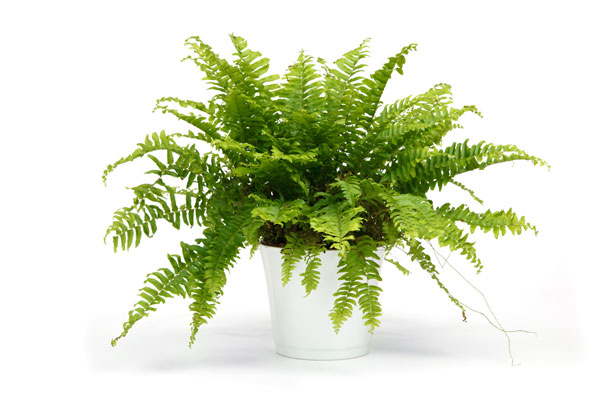
Some effective plants are very easy for anyone to grow. Common English Ivy (Hedera helix) which ranked sixth in the NASA list, has antioxidant and anti-inflammatory properties and has positive effects on upper respiratory conditions. Boston Fern (Nephrolepis exaltata) is a particularly good filtering plant, removing formaldehyde, xylene and toloulene.
A little research can help determine which of the recommended plants are better for your personal needs. Some may address your health problems better than others.
There are many other beneficial plants not included on this list. Gerbera reduces levels of the chemical solvent benzene. Chrysanthemum, the extremely hardy Spider plant and Aloe, are others you could also find helpful.
For best results you need about 15 plants for a 15 square home or 140m² office to keep the air clean.
Make your home & workspace motto
‘MORE GREEN – LESS STRESS’
DISCLAIMER
All information and opinions presented here are for information purposes only and are not intended as a substitute for professional advice offered during a consultation. Please consult with your health care provider before following any of the treatment suggested on this site, particularly if you have an ongoing health issue.
SOURCE ARTICLES
Bijlsma, N, Healthy Home Healthy Family, Joshua Books, 2010
 Happy Holistic Health