
Does this sound familiar?
Life is really stressful and more often than not you’re close to overwhelm. You know this level of stress is negatively impacting your health. It feels like it’s overtaken your life. Sometimes you can’t even remember what complete wellness feels like. As you collapse into bed each night you feel resentful that you’re too stressed and exhausted to have truly meaningful relationships with the ones you love the most.
You feel overloaded with advice to reduce stress. But in spite of so much advice you can’t even work out where to begin.
Sometimes there’s just too much advice available!
When this happens, it’s time to go back to basics.

Back to Centre
When you’re overwhelmed the key to shifting back to centre is always to ground yourself. The classic way is to walk barefoot on the earth.
Luckily that’s not the only way to effectively ground yourself.
One of the simplest ways to come back to centre is through your five senses – sight, sound, smell, touch and taste. The beauty of this grounding method is you can do it anywhere and anytime. Plus, you can adapt it to suit your situation no matter what you’re doing or where you are. You don’t have to go outside or take your shoes off!
I introduce this technique in workshops because it brings participants right into the present. When they’re grounded in the moment, they get far more out of the session.
The same applies to you in your life. When you’re grounded in the present moment your awareness sharpens so you perceive what’s around you with greater clarity. You stay calm and centred without being drawn into the drama. You stop spinning out when things threaten to overwhelm you.
Staying grounded helps you make better judgements and decisions so you can plot a decisive course of action. It also leaves you energised. But the best thing is your ability to ground in the moment continues to increase as this becomes a daily practice.
Sensory Grounding
Sensory Grounding is a simple technique which involves tuning deeply into your environment through each of your five senses.
Most of us rely heavily on just one or two senses. Most people’s preferred sense is sight. But when we use all our senses to engage with the environment rather than just the preferred ones, we generate much deeper levels of perception. We also engage more coherently with our Higher Wisdom.
Develop Sensory Awareness and Relieve Stress
In this exercise we develop stronger ability to notice our environment. Using greater perception, we push awareness through each of our senses in turn. As we do this activity over time our senses and awareness become more acute.
To benefit from this powerful practice, do the Sensory Grounding Exercise right through as described. Once you’ve done the full exercise introduce it into your daily practice. To leave yourself feeling completely calm and grounded dedicate 5-8 minutes to each of the five senses. However, you’ll still get some benefit if you only have 1-2 minutes to dedicate to each.
Because we rely heavily on our sense of sight do it last in this exercise. Once you’ve already started grounding through your other senses, you’ll engage with your vision sense more easily and effectively.
Be aware of anything that’s ‘triggered’ throughout this exercise. For example, the sense of smell is the most closely linked to memory and certain smells may give rise to particular emotions. Open yourself to both these and new aromas. Humans can distinguish 10,000 different smells so engaging with your sense of smell can greatly expand your sensory awareness.
Start with a sense which you rely on less often. Do the exercise, then after you’ve engaged fully through that sense move on to another one. The order doesn’t matter apart from ending with sight. Close your eyes through the exercise until you reach the sense of sight at the end.
Sensory Grounding Exercise
Wherever you do this exercise, at home, at work, outside in nature, in a busy café or in bed at night, you’ll be amazed at how much you notice when you really become aware of all that surrounds you.
Do the exercise sitting, standing or lying, but it’s best not to move around.
Find somewhere to get comfortable with your feet firmly on the floor. You don’t need to be alone or quiet.
Close your eyes and breathe deeply, taking your attention to the out-breath.
Hearing
Let your breath find its own rhythm as you gently take in the sounds around you. Initially notice the most prominent sounds, voices, a dog bark, birds chirping, cars, maybe power tools or other noisy equipment. Notice sounds come and go as objects or people move in and out of your hearing.
Now tune in to the sounds underneath; the low hum of a refrigerator, tapping of a keyboard, noises outside or in another part of the building, sounds in the distance.
Notice your own sounds; your breath, the almost imperceptible rustle of your clothing, your hair brushing against your collar as you move your head.
Turn ninety degrees and notice how the sounds change. Turn again until you return to your starting position, noticing how different it sounds from each direction.
Now cover one ear. Hear the sounds coming through the other ear and notice how they’re different to those you notice through both ears at once. Do this for your other ear.
Smell
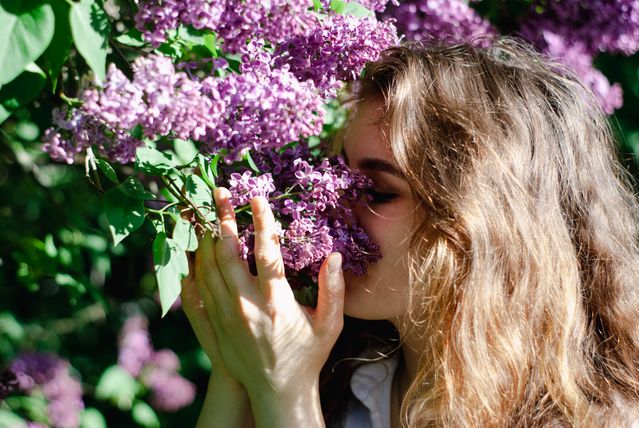
When you’ve finished absorbing all you can through your hearing turn your attention to your sense of smell. Take a deep breath in through your nose and notice what aromas are the strongest. Notice the pleasant and unpleasant smells without rejecting any as this is all about awareness not judgement.
Now move to the more subtle smells, they may be further away, or softer, or fleeting. Notice what you notice.
Once you’ve absorbed all the aromas turn ninety degrees and notice whether you perceive new smells or whether any become stronger or fainter. Repeat until you return to your starting position.
As you did with your sense of hearing, close one nostril and notice any changes. Repeat for the other side.
When you feel you’ve exhausted this sense move on to the next one.
Taste
Run your tongue right around your mouth. What do you notice? Does it taste different in different parts of your mouth? Can you taste something you ate earlier? What about your saliva, does it have a taste you recognise?
This part of the exercise also engages with your sense of touch. Try to focus on just the taste you experience rather than the feel on your tongue.
Open your mouth a little. What can you taste in the air that flows in? What if you open your mouth wide?
Do you notice tastes coming in from more distant surroundings? Your sense of taste and sense of smell are closely connected so you may ‘taste’ foods being cooked nearby.
Lick the skin of your hand. What do you notice?
Stay with the sense of smell for another moment as you let yourself sink deeply into it.
Touch
Now move on to the sense of touch. We ‘feel’ both on the surface of our skin and within our body. In this exercise you want to become aware of both of these senses of touch.
Start by touching your hands together. Notice the feeling on your skin. You will feel both what the skin feels like and what it like to be touched.
Focus on what your skin feels like first. Do both hands feel the same or are they different? How do the back and palm feel different? Notice everything about the feel of your skin, is it dry or moist, warm or cold, smooth, cracked, rough, tight or loose and so on.
Now switch your attention to the internal feeling of what it feels like to be touched. Does it tickle, soothe, scratch? Does the feeling run up your arm or through your fingertips?
Try changing the pressure and notice what that feels like.
Now separate your hands and hold them up in the air? Notice what that feels like? Can you feel a breeze as someone walks past, coldness, warmth?
Notice the feel of any other external things like the warmth of the sun, or the wetness of the rain.
Shift your attention within your body. Do a quick scan starting at the toes and moving up through every part. What do you notice? Don’t forget to notice what the connection between your feet and the floor or ground feels like.
Take a moment to really cement that feeling of your feet solidly connecting with the ground beneath you.
Sight
And now we move onto the final sense, sight.
Half open your eyes and gaze gently in front of you. Try not to focus on any particular object, you want to get a ‘sense’ of what you see first.
Notice the tone of the light, a general sense of colours without focusing on any single one, whether there’s movement or calm stillness.
Once you have a general sense for what is around you, open your eyes completely and begin to notice in more detail. Start with the bigger more dominant items and gradually take your focus closer and closer in to notice small details.
Continue to notice what surrounds you. Turn to face different directions or look above your head or down to the ground if you wish.
Although sight is the sense you are normally most aware of, notice how much more you notice when you really connect with sight during this exercise. Become aware of how much you must miss in your life as you give just part of your awareness to your world.
Spend a few more moments enjoying your “new vision”. Take three deep breaths before moving your arms, feet and body.
Integration
Now that you’ve finished the sensory part of this exercise it’s important to integrate your experience.
Journalling your thoughts and insights helps you gain more clarity about what you experienced. However, if you cannot journal, pause for a few minutes to consider how you feel right now? Do you feel calm, solid and grounded? Do you feel more at peace? More focused? Greater clarity?
Awareness is a potent tool that helps us rebalance when we feel confused, frustrated or overwhelmed. As we become efficient at maintaining detached awareness, we can ride the waves of turmoil to keep ourselves outside the drama.
Regularly practicing this exercise strengthens your ability to harness focus, calm and clarity. As the exercise becomes more familiar you can draw all its benefits through even short one-to-two-minute bursts of sensory awareness.
60 Ways To Engage With Your Senses
Use these 60 ways to engage with your senses through your day. Some can go on in the background of your daily life. They’ll all help ground you to varying degrees.
To continue developing sensory awareness you need to dive deeper with these practices just as you did in the Sensory Grounding Exercise. To fully reap the stress reducing benefits become aware of how your sense is stimulated and allow it to engage completely.
To help stimulate your senses introduce into your life any which resonate with you. Also include those that don’t resonate as they may be the ones that lead to the greatest growth.
Notice when multiple senses are stimulated at the same time and maintain your awareness of each individual sensory response.
- Sing
- Laugh
- Chat with someone who listens
- Chew gum
- Eat quality chocolate, ‘rough’ feeling, or sour food
- Read a story aloud creating different voices for each character
- Breathe deeply
- Exercise. Move with measured tai chi slowness. Dance
- Stroke a pet, especially cats, dogs and rabbits
- Wear really soft clothing, or silky clothing, or very rough clothing
- Bake, and breathe in the smells
- Cleanse your palate with lukewarm water between different foods
- Cook and enjoy the repetitive motions of chopping or stirring
- Walk through a scented garden
- Sit by a gurgling brook and notice the scents, sounds and feel on your skin
- Dangle your feet in the water
- Grind coffee beans and then brew coffee
- Walk by the ocean, notice the smell, taste and feel
- Burn essential oils
- Go outside after rainfall
- Cook a curry, breathe in the aroma, taste the spices
- Paint. Focus on the colour and texture
- Create a collage from many different materials
- Try photography using different settings (not filters) to create different effects
- Daydream
- Read an actual book, notice how it feels, smells, or the sound of the pages turning
- Do a visualisation
- Sit outside with your eyes closed
- Listen to music with eyes closed
- Run water over your hands
- Cut a bunch of different herbs; run your fingers through the bushes, crush the leaves
- Listen to classical music and follow the sound of just one single instrument through the entire piece
- Take off your shoes and wriggle your toes in the sand
- Knead dough
- Go out in the garden, pull some weeds, get your hands dirty
- Close your eyes and listen to an old wind-up clock
- Sit or walk amongst farm animals
- Lean over the cooking pot and breathe in the aroma
- Hang wind chimes outside an open window
- Put down your phone and use your hands
- Knit or crotchet
- Work with clay, do pottery
- Doodle, or colour mandalas
- Have a massage
- Stroke your forearm
- Rub your feet gently
- Soak in scented bathwater
- Colour your plate with a vegetable rainbow
- Stimulate your bitter taste buds with fresh endive, rocket (arugula), dandelion leaves, grapefruit, apple cider vinegar, Brussels sprouts, cranberries, chicory
- Hold hands
- Explore your world through a magnifying glass
- Smell your food or drink before you eat it
- Eavesdrop on a conversation in a foreign language
- Visit an art gallery and notice the detail in each work
- Sit around a campfire
- Whittle
- Squeeze a stress ball
- Notice the shifts in light and colour as a breeze gently moves the leaves
- Join a wine tasting class and discover what you smell
- Next time you’re a car passenger close your eyes and become aware of all the different sensory experiences
Discover how your senses can indicate your psychic strengths in ‘The 8 Clair Senses: Your Intuitive Psychic Senses.’

Disclaimer
Information and opinions presented here are for information only and are not intended as a substitute for professional advice offered during a consultation. Consult with your health care provider before trying treatment suggested on this site.
© Catherine Bullard and Happy Holistic Health, 2012. Unauthorised use and/or duplication of this material without express and written permission from this blog’s author/owner is strictly prohibited. Excerpts and links may be used, provided full and clear credit is given to Catherine Bullard and Happy Holistic Health with appropriate and specific direction to the original content

