
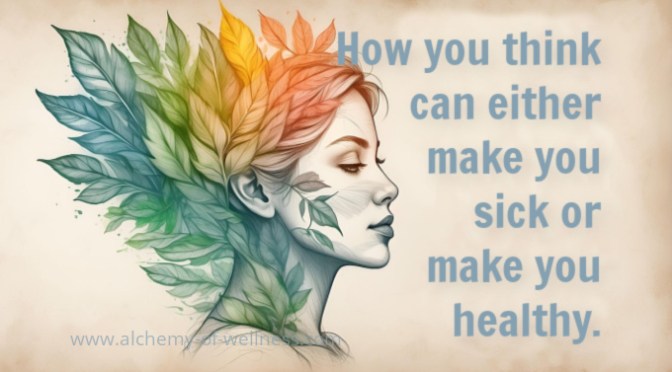
Your thoughts can have a huge impact on your health. The human mind is the most powerful supercomputer in the world. It controls all the functions of your body, your behaviour, and your emotions. But your mind doesn’t necessarily control you, and recent research shows that you have the power to control your mind. The secret lies in the way you think because thoughts affect health. It turns out the power of positive thought may be stronger than we thought, and it can be harnessed to create health and wellbeing. The way you think can either make you sick or it can make you healthy.
IMPACT OF THOUGHTS
How we think determines how we speak and what we talk about which then impacts how we feel. Every decision, choice and action we make is influenced by how we feel.
Studies have shown that our mindset can change us in ways we had not imagined possible. So, science is now considering that if mindset can change us, can we then deliberately choose our mindset to improve our abilities. And the answer appears to be yes.
The cells in your body react to your thinking. Your thoughts can literally change your health by altering the cells and how they function. Every thought you have causes neurochemical changes within your brain and these can either help or harm you.
THOUGHTS AFFECT HEALTH
Your thoughts can alter your performance. They can alter your engagement and enjoyment of life. They can even alter your energetic body.
This really is a case of mind over matter.

Studies have produced much evidence that the way we think both creates and changes real-life physical and mental outcomes.
Our expectations can change brain chemistry and circuitry. Positive expectations result in cognitive and physiological changes such as reduced anxiety, elevated hormone levels, or lower immune system reactions. Thoughts alone can improve our vision, weight loss, fitness, fatigue level, and can even stop allergic skin reactions.
Essentially your brain is shaped by your thoughts. And apparently your health and wellness is too.
THE PLACEBO EFFECT
Dr Lissa Rankin MD conducted extensive research into how negative thoughts affect brain health. She became convinced that a combination of positive belief and nurturing care activates the body’s natural self-repair mechanisms and helps the body heal itself. “The medical establishment has been proving that the mind can heal the body for over 50 years. We call it ‘the placebo effect,’ she says.
But, as she explains in her book Mind Over Medicine: Scientific Proof That You Can Heal Yourself the opposite is also true. Negative beliefs you hold about your health, or harsh insensitive treatment by the health care system can poison your body.
Your thoughts have a long-term impact on your brain. The messages sent through your nervous system cause patterns of neural activity. When the same thoughts are repeated over and over they actually change neural pathways in your brain. The more frequently you have the same thoughts the busier these pathways get. And the busier these pathways, the stronger and more sensitive the neural connections become.
NEGATIVE THOUGHTS
If you bombard your cells with negative thoughts you programme your cells to receive more negative thoughts. You also reduce the number of receptors for positive thoughts. You increase your pessimism and it then becomes more difficult to even have positive thoughts.
Similarly, if you focus on positive thoughts you increase your cell’s ability to receive positive thoughts and reduce negative thought receptivity.
When you’re focused on negative thoughts your body fills with the harmful stress hormones cortisol and adrenaline. But when you replace negative thinking with positive thoughts your nervous system relaxes. Your body can heal.
There are many examples of the power of positive thinking demonstrated by the placebo effect. The body heals itself if it believes it’s taking or doing something that heals, even if it’s only a sugar pill. Similarly, if you’re convinced you have mastered a new skill your body will then be able to perform it.
The opposite state to placebo is termed the “nocebo effect” and it demonstrates the physiological effects on your body of negative belief, fear, and anxiety. Negative thoughts and emotions trigger the amygdala, the part of the brain that triggers the “fight, flight or freeze” stress response.
The stress response is a throw-back to cave-man days, a response designed to switch on whenever you were facing danger. It would then switch off again as soon as the danger had passed and the nervous system would relax. In our modern world this response often engages when we experience chronic stress or negative thinking. However, because the stress is ongoing the response doesn’t disengage. We remain in the fight-flight-freeze stress response.
If your nervous system gets stuck in this response you become more predisposed to illness because the body’s self-repair mechanisms don’t function well.
CHANGE NEGATIVE THOUGHTS

Neural pathways formed by continued negative thoughts can be consciously changed. The good news is it only takes about thirty minutes a day to establish new pathways.
Adopting strategies that support new thinking are a great way to establish new habits. Ninety-eight percent of all behaviour is subconscious so changing a habit of negative thinking requires you to take conscious daily action until new thought patterns have become automatic.
POSITIVE THOUGHT FOCUS
Positive Thought Strategies
Focus on these strategies to develop the habit of positive thoughts.
- Affirmations
- Visualisation
- Vision boards
- Giving thanks
- Saturating your consciousness with positive audio and reading
- Replacing negative self-talk
AFFIRMATIONS
Your subconscious cannot tell the difference between fact and fiction; it simply believes whatever you tell it. When we repeat positive affirmations, our brain takes the message in the affirmation as fact. In effect, we are telling our subconscious we already have something before it arrives. Or we are projecting a quality onto ourselves that we may not comfortably accept we have.
Repeating statements formed to be happening in the present moment such as “I love my work and am paid abundantly” sends a positive message to the subconscious, which believes whatever you tell it. Phrasing affirmations like this is far stronger than affirmations like ” I will be paid abundantly” which is projected into the future.
Affirmations need to repeated frequently through the day and continued until the new mindset has become established
VISUALISATION
Like affirmations, visualisation is again effective because of the inability of the subconscious to tell what is real and what is vividly imagined. Making simple visualisation techniques a part of your daily life helps establish new habits and new thoughts.
VISION BOARDS
Vision boards are a collection of images of the ideal life you’d like to have. They are great for visual thinkers bringing their focus and thoughts to happy positive possibilities. Whenever you look at a vision board it will evoke happy thoughts. It only takes a few seconds for your brain to retain an image and looking at the same positive image frequently quickly helps form positive thinking. Vision boards can be kept on a computer, on cardboard, framed on a wall.
GIVING THANKS
Practicing gratitude is not just a case of convincing yourself that things are great, nor is it deluding yourself that negative things don’t exist. Whenever you practice gratitude you brain releases a flood or neurotransmitters like dopamine, the ‘happy hormone’, rewarding you with a sense of alertness and general happiness.
Your brain quickly learns to seek out more of these feel-good experiences, switching your thoughts from negative to positive.
REPLACING NEGATIVE SELF TALK
When we’re in the habit of negative thinking we tend to use dis-empowering words such as “I can’t”, “it’s no use”, “I should/must/won’t” and many others. Recognising when we use these words and consciously replacing them with empowering words can begin to change those neural pathways. Phrases such as “how can I”, “I trust”, “I am popular” are just a few that lift your feelings about yourself and pave the way for more positive thoughts.
TAKE CONTROL OF NEGATIVE SELF-TALK
Of course, positive thoughts and attitudes are not the only answer, and they can’t entirely control what happens to your health. Genetics still play a part and accidents still happen. But although you may not be able to prevent these, the way in which you think and respond particularly when it comes to fear, affects how well you recover and move on.
The power to influence and even direct your physical health, your emotions and your mental experience lies firmly with you. Every cell right down to your DNA is tuned into your thoughts. Choosing to keep your thoughts positive, focusing on gratitude and other positive practices, and locking positive recognition into your physical body will keep you healthier and happier.
It’s up to you. You’re the only one who can govern the nature of your thoughts, and it’s your responsibility to consciously direct your thoughts.
Source Articles
http://www.mindbodygreen.com/0-9690/scientific-proof-that-negative-beliefs-harm-your-health.html
http://www.scientificamerican.com/article/your-thoughts-can-release-abilities-beyond-normal-limits
Disclaimer
The Information contained on this site is for your general health information. It is not intended to be used as medical advice and should not be used to diagnose, treat, cure or prevent any medical condition, nor should it be used for therapeutic purposes. The information is not a substitute for independent professional advice and should not be used as an alternative to professional healthcare. If you have a particular medical problem, please consult a healthcare professional.
© Catherine Bullard and Happy Holistic Health, 2012. Unauthorised use and/or duplication of this material without express and written permission from this blog’s author and/or owner is strictly prohibited. Excerpts and links may be used, provided that full and clear credit is given to Catherine Bullard and Happy Holistic Health with appropriate and specific direction to the original content

