Tag Archives: change mindset

Pay Attention With Mindfulness

Create Calm Through Conscious Awareness

Mindfulness is the art of being present and 
accepting the moment, as it is.

Mindfulness is the energy of being both aware and awake to the present moment. It is the ongoing practice of engaging fully in every moment of daily life and accepting it without judgement. It is about simply Being instead of constantly Doing.

Recently I was reading about mindfulness while I was eating a slice of toast.  As I continued to read, I suddenly became very conscious of the irony of my situation.  Engrossed in the internet, with thoughts of what I needed to do during the day running around in the background, I was eating in a way totally lacking in mindfulness.

So I stopped reading and focused on the delicious food.  I immersed myself in experiencing the bread toasted so that just the outside was crunchy and the centre still moist; the tang of the sourdough culture; the seeds coating the crust; the sweetness of warm butter which had soaked through into the heart.

I noticed the autumn sun pouring in through the window and the small birds hopping along the branches outside. 

At one point I began thinking about writing this post about mindfulness, but being mindful, I put the thought aside and focused on eating the toast again. Truly, I tasted and enjoyed that piece of toast far more deeply than many I have eaten. It was all the more delicious because I was focused in the moment.

“When we are mindful, deeply in touch with the
present moment, our understanding of what
is going on deepens, and we begin to be
filled with acceptance, joy, peace and love.”

Thich Nhat Hanh

My distraction while I was eating is completely normal. Human consciousness focuses on a lively dance between revisiting past events and anticipating the future. But developing mindfulness in our daily routine can have a very positive impact on our lives as well as our health.

Conscious Awareness

Mindfulness is a hot topic right now, but it’s nothing new. It involves the art of consciously living in the present moment without getting drawn into the drama.

At its simplest mindfulness can be likened to awareness with intent.  It’s about using awareness to observe and notice in an open and curious way. 

Mindfulness and intentional awareness are both about paying attention with purpose. They are like being in the eye-of-the-storm and still being able to consciously hold the place of stillness, while all around is chaos. They allow you to live in the here and now, noticing with clarity the reality behind what’s appears to be going on, while remaining emotionally detached.

Mindfulness Changes Your Brain

This mindfulness practice of touching life deeply in every moment of daily life brings heightened awareness and inner calm.

When we practice mindfulness, we become more open to noticing what is happening in our lives, with greater clarity. Everyday problems do not disappear. But because we are fully present in our lives through the practice, we become able to respond to life’s pressures in a much calmer way. 

Developing and strengthening your awareness with mindfulness can transform your brain by changing or creating new circuits particularly those involved in stress, attention and focus, memory and mood. Mindfulness changes the way neurons in your brain communicate with each other. This opens the opportunity for you to interact and respond to your experiences and the world around you in a whole new way.

Mindfulness also helps us avoid self-judgement and self-criticism as we become more accepting of both our strengths and our challenges. This brings significant health benefits to our body, our mind and our soul.

Embracing the energy of mindfulness and allowing it to flow into our lives to penetrate everything we do provides us with the opportunity to foster the development of grace within. 

It deepens our capacity to live more meaningful, balanced and peaceful lives.

Origins of Mindfulness

The ancient practice of mindfulness has come to us through many eastern philosophies including Buddhism, Yoga, Tai Chi and Taoism. It’s now embraced by the West and widely taught in a non-sectarian way because it is a proven effective tool to treat many psychological clinical disorders.

Thich Nhat Hanh, a Vietnamese Buddhist monk, teacher, author, poet and peace activist, taught the art of mindfulness throughout his lifetime. Initially he taught it through the practice of mindful breathing and later through Walking Meditation. Walking Meditation is more than just strolling around. It’s about being peacefully rooted in the present and always aware of both your mind and body as you move.

Walking meditation provides additional benefits to those gained through mindfulness, such as improved blood sugar levels1 and blood flow and better balance and ankle coordination.

Benefits of Mindfulness

Mindfulness has been proven to effectively counteract stress by intentionally focusing the attention on the present moment and at the same time, accepting it without judgement.   Focusing on the present moment prevents you becoming caught up in worry about the future or regret or shame about the past.

The Benefits
  • Improves clarity, focus and concentration
  • Stimulates creativity 
  • Helps develop a stable mind to stay grounded, rather than one that is dull or agitated
  • Reduces anxiety by cultivating a flexible mind able to reduce the impact of stressful thoughts and feelings
  • Increases self-awareness of your mind and its thought patterns
  • Helps you become less reactive in difficult and challenging situations
  • Replaces self-defeating behaviours with more beneficial ones

Mindful Practice

We are so familiar with projecting our attention and thoughts into either the future or the past, that it can take time to become proficient in maintaining your awareness in the present moment. But it can be developed through repetition until it becomes natural and automatic.

Whenever you think of it, practice by focusing on your breath, your surroundings or on each of your five senses – sound, sight, smell, touch and taste in turn. Tune into your thoughts or your body and just observe what you notice without any judgement or self-recrimination. Hold this state as long as you find comfortable and notice how much calmer it leaves you feeling.

Mindfulness leads to a keener awareness of all aspects
of your life and the world around you

Every time you can bring your mind into the NOW, even just momentarily, you help cultivate a mindfulness practice that will eventually become a permanent and automatic part of how you function.

Commit to cultivating mindfulness in your life today, to gain profound and sustained benefits.
  1. Effects of Buddhist walking meditation on glycemic control and vascular function in patients with type 2 diabetes https://doi.org/10.1016/j.ctim.2016.03.009
Disclaimer

    All information and opinions presented here are for information only and are not intended as a substitute for professional advice offered during a consultation. Please consult with your health care provider before trying any of the treatment suggested on this site. 

    © Catherine Bullard and Happy Holistic Health, 2026. Unauthorised use and/or duplication of this material without express and written permission from this blog’s author and/or owner is strictly prohibited. Excerpts and links may be used, provided that full and clear credit is given to Catherine Bullard and Happy Holistic Health with appropriate and specific direction to the original content.
    Sick Or Healthy: It’s In Your Thoughts

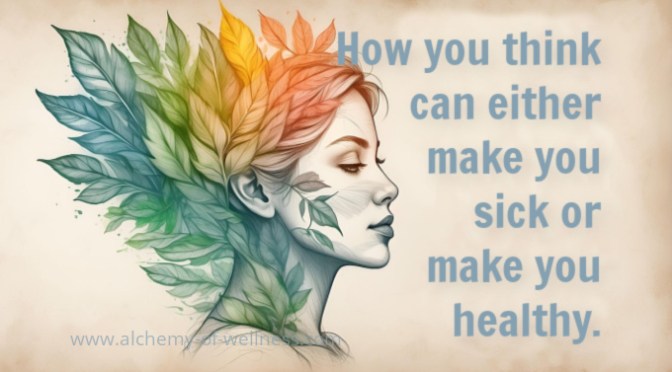
    Your thoughts can have a huge impact on your health. The human mind is the most powerful supercomputer in the world. It controls all the functions of your body, your behaviour, and your emotions. But your mind doesn’t necessarily control you, and recent research shows that you have the power to control your mind. The secret lies in the way you think because thoughts affect health. It turns out the power of positive thought may be stronger than we thought, and it can be harnessed to create health and wellbeing. The way you think can either make you sick or it can make you healthy. 

    IMPACT OF THOUGHTS

    How we think determines how we speak and what we talk about which then impacts how we feel. Every decision, choice and action we make is influenced by how we feel.

    Studies have shown that our mindset can change us in ways we had not imagined possible. So, science is now considering that if mindset can change us, can we then deliberately choose our mindset to improve our abilities. And the answer appears to be yes.

    The cells in your body react to your thinking. Your thoughts can literally change your health by altering the cells and how they function. Every thought you have causes neurochemical changes within your brain and these can either help or harm you.

    THOUGHTS AFFECT HEALTH

    Your thoughts can alter your performance. They can alter your engagement and enjoyment of life. They can even alter your energetic body.

    This really is a case of mind over matter.

    Studies have produced much evidence that the way we think both creates and changes real-life physical and mental outcomes.

    Our expectations can change brain chemistry and circuitry. This can result in cognitive and physiological changes such as reduced anxiety, elevated hormone levels, or lower immune system reactions. Thoughts alone can improve our vision, weight loss, fitness, fatigue level, and can even stop allergic skin reactions.

    Essentially your brain is shaped by your thoughts. And apparently your health and wellness is too.

    THE PLACEBO EFFECT

    Dr Lissa Rankin MD conducted extensive research which convinced her that a combination of positive belief and nurturing care activates the body’s natural self-repair mechanisms and helps the body heal itself. “The medical establishment has been proving that the mind can heal the body for over 50 years. We call it ‘the placebo effect‘”, she says.

    But, as she explains in her book Mind Over Medicine: Scientific Proof That You Can Heal Yourself the opposite is also true. Negative beliefs you hold about your health, or harsh insensitive treatment by the health care system can poison your body.

    Your thoughts have a long-term impact on your brain. The messages sent through your nervous system cause patterns of neural activity. When the same thoughts are repeated over and over they actually change neural pathways in your brain. The more frequently you have the same thoughts the busier these pathways get. And the busier these pathways, the stronger and more sensitive the neural connections become.

    NEGATIVE THOUGHTS

    Save

    If you bombard your cells with negative thoughts you programme your cells to receive more negative thoughts. You also reduce the number of receptors for positive thoughts. You increase your pessimism and it then becomes more difficult to even have positive thoughts.

    Similarly, if you focus on positive thoughts you increase your cell’s ability to receive positive thoughts and reduce negative thought receptivity.

    When you’re focused on negative thoughts your body fills with the harmful stress hormones cortisol and adrenaline. But when you replace negative thinking with positive thoughts your nervous system relaxes. Your body can heal.

    There are many examples of the power of positive thinking demonstrated by the placebo effect. The body heals itself if it believes it’s taking or doing something that heals, even if it’s only a sugar pill. Similarly, if you’re convinced you have mastered a new skill your body will then be able to perform it.

    The opposite state to placebo is termed the “nocebo effect” and it demonstrates the physiological effects on your body of negative belief, fear, and anxiety. Negative thoughts and emotions trigger the amygdala, the part of the brain that triggers the “fight, flight or freeze” stress response.

    The stress response is a throw-back to cave-man days, a response designed to switch on whenever you were facing danger. It would then switch off again as soon as the danger had passed and the nervous system would relax. In our modern world this response often engages when we experience chronic stress or negative thinking. However, because the stress is ongoing the response doesn’t disengage. We remain in the fight-flight-freeze stress response.

    If your nervous system gets stuck in this response you become more predisposed to illness because the body’s self-repair mechanisms don’t function well.

    CHANGE NEGATIVE THOUGHTS

    Neural pathways formed by continued negative thoughts can be consciously changed and the good news is it only takes about thirty minutes a day to establish new pathways.

    Adopting strategies that support new thinking are a great way to establish new habits. Ninety-eight percent of all behaviour is subconscious so changing a habit of negative thinking requires you to take conscious daily action until new thought patterns have become automatic.

    POSITIVE THOUGHT FOCUS

    Focus on these strategies to develop the habit of positive thoughts.

    • Affirmations
    • Visualisation
    • Vision boards
    • Giving thanks
    • Saturating your consciousness with positive audio and reading
    • Replacing negative self-talk

    AFFIRMATIONS

    Your subconscious cannot tell the difference between fact and fiction; it simply believes whatever you tell it. When we repeat positive affirmations, our brain takes the message in the affirmation as fact. In effect, we are telling our subconscious we already have something before it arrives. Or we are projecting a quality onto ourselves that we may not accept.

    Repeating statements formed in the now such as “I love my work and am paid abundantly” sends a positive message to the subconscious, which believes whatever you tell it.

    Affirmations need to repeated frequently through the day and continued until the new mindset has become established

    VISUALISATION

    Like affirmations, visualisation is again effective because of the inability of the subconscious to tell what is real and what is vividly imagined. Making simple visualization techniques a part of your daily life helps establish new habits and new thoughts.

    VISION BOARDS

    Vision boards are a collection of images of the ideal life you’d like to have. They are great for visual thinkers bringing their focus and their thoughts to happy positive possibilities. Whenever you look at them they will evoke happy thoughts. It only takes a few seconds for your brain to retain an image and looking at the same positive image frequently helps form positive thinking quickly. They can be kept on a computer, on cardboard, framed on a wall.

    GIVING THANKS

    Practicing gratitude is not just a case of convincing yourself that things are great, nor is it deluding yourself that negative things don’t exist. Whenever you practice gratitude you brain releases a flood or neurotransmitters like dopamine, the ‘happy hormone’, rewarding you with a sense of alertness and general happiness.

    Your brain quickly learns to seek out more of these feel-good experiences, switching your thoughts from negative to positive.

    REPLACING NEGATIVE SELF TALK

    When we’re in the habit of negative thinking we tend to use dis-empowering words such as “I can’t”, “it’s no use”, “I should/must/won’t” and many others. Recognising when we use these words and consciously replacing them with empowering words can begin to change those neural pathways. Phrases such as “how can I”, “I trust”, “I am popular” are just a few that lift your feelings about yourself and pave the way for more positive thoughts.

    CONTROL NEGATIVE SELF-TALK

    Of course, positive thoughts and attitudes are not the only answer, and they can’t entirely control what happens to your health. Genetics still play a part and accidents still happen. But although you may not be able to prevent these, the way in which you think and respond particularly when it comes to fear, affects how well you recover and move on.

    The power to influence and even direct your physical health, your emotions and your mental experience lies firmly with you. Every cell right down to your DNA notes your thoughts. Choosing to keep your thoughts positive, focusing on gratitude and other positive practices, and locking positive recognition into your physical body will keep you healthier and happier.

    It’s up to you. You’re the only one who can govern the nature of your thoughts, and it’s your responsibility to consciously direct your thoughts.

    Source Articles

    http://www.mindbodygreen.com/0-9690/scientific-proof-that-negative-beliefs-harm-your-health.html

    http://www.scientificamerican.com/article/your-thoughts-can-release-abilities-beyond-normal-limits

    Disclaimer

    The Information contained on this site is for your general health information. It is not intended to be used as medical advice and should not be used to diagnose, treat, cure or prevent any medical condition, nor should it be used for therapeutic purposes. The information is not a substitute for independent professional advice and should not be used as an alternative to professional healthcare. If you have a particular medical problem, please consult a healthcare professional.

    © Catherine Bullard and Happy Holistic Health, 2012. Unauthorised use and/or duplication of this material without express and written permission from this blog’s author and/or owner is strictly prohibited. Excerpts and links may be used, provided that full and clear credit is given to Catherine Bullard and Happy Holistic Health with appropriate and specific direction to the original content